Stem Cells in Spinal Muscular Atrophy (SMA): Real Potential, Limits of Possibilities, and Prospects of Cell Therapy
Date: August 2026

Date: August 2026
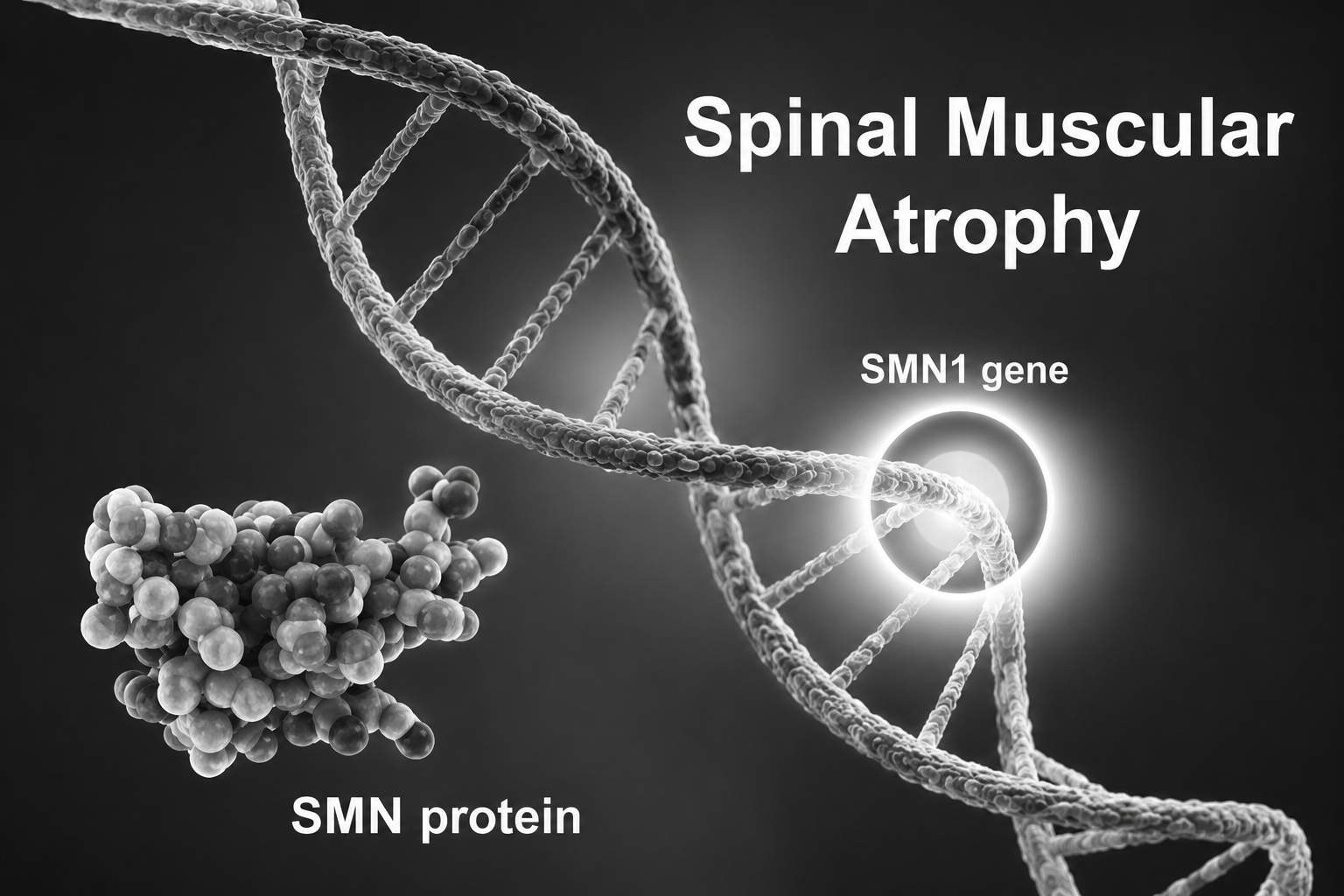
Spinal muscular atrophy (SMA) is a severe genetic disorder that affects the motor neurons of the spinal cord and leads to progressive muscle weakness. The main manifestation of spinal muscular atrophy (SMA) is progressive muscle weakness and atrophy that affect the body symmetrically. This leads to reduced muscle tone, mobility problems, and difficulties during breathing and swallowing, while the patients’ intellect is completely preserved. The severity and danger of the disease depend on the type of spinal muscular atrophy.
How is spinal muscular atrophy (SMA) inherited?
SMA is inherited in an autosomal recessive pattern. This means that a child is born with the disease only when both parents are carriers of a mutation in the SMN1 gene. In this case, the probability of having an affected child is 25%. The probability of having a healthy child is 75%, specifically: a child who will be a carrier of the gene – 50%; completely without the gene mutation – 25%.
If only one of the parents is a carrier, the child will not develop SMA (although they may inherit carrier status).
What SMA treatment methods exist?
With the advent of targeted gene therapy, the direction of the fight against the disease has changed: an opportunity to stop its progression has emerged. Modern evidence-based medicine has three main approved drugs (Zolgensma, Spinraza, Risdiplam) that address the root cause – the SMN1 gene or its backup gene, SMN2.
Zolgensma delivers a new, fully functional copy of the SMN1 gene into the nuclei of the patient’s cells using an adenovirus. The drug is administered once intravenously. The healthy gene begins to independently and continuously produce the full-length SMN protein. The introduced gene functions autonomously (as an episome) alongside the cell’s own DNA.
Spinraza is a synthetic nucleic acid fragment. The drug is administered intrathecally every 4 months throughout life. Spinraza modifies the action of the backup SMN2 gene, allowing it to be read correctly and produce the full-length, stable SMN protein in sufficient quantities.
Risdiplam is taken orally at home. The drug enters the systemic circulation, increasing the level of the SMN protein not only in the central nervous system, but also in the liver, muscles, and other internal organs.
Despite the availability of progressive gene therapy, scientists and doctors still face the questions: how to help restore the nerve and muscle tissue that has already undergone degeneration? How to help children who did not have time or are unable to receive targeted gene therapy?
Cell therapy attracts particular attention from clinicians, specifically the use of mesenchymal stem cells (MSCs) and umbilical cord blood mononuclear cells to restore or support the body of a patient with SMA.
How do stem cells work in spinal muscular atrophy?
Today, it is proven that administered stem cells do not differentiate into new alpha motor neurons and do not replace lost spinal cord cells. The primary value of MSCs in neurodegenerative pathologies lies in their paracrine (secretory) and immunomodulatory effects:
Why doesn’t cell therapy replace the basic treatment of SMA?
SMA is a monogenic disease caused by a mutation or deletion in a gene. No stem cells (autologous or donor-derived) eliminate the root cause of SMA – the genetic mutation. That is why cell therapy is not a monotherapy or an alternative to disease-modifying drugs. Without restoring the SMN protein level, any neuroprotective effect of the cells will be short-term. Research and clinical base for the use of MSCs To date, the use of MSCs in SMA is predominantly at the stage of preclinical trials (in vitro and animal models) and isolated Phase I/II clinical observations:
Prospect: combined therapy in spinal muscular atrophy (SMA)
The synergistic (combined) approach is considered the most promising direction in global regenerative neurology:
Scientific sources and literature:
Emerging Gene Therapy Approaches in the Management of Spinal Muscular Atrophy (SMA). MDPI International Journal of Molecular Sciences, 2023. Allogeneic mesenchymal stem cell therapy outcomes for patients with spinal muscular atrophy type 1. PubMed / NCBI, 2015. Spinal Muscular Atrophy Modeling and Treatment Advances by Induced Pluripotent Stem Cells Studies. Frontiers in Cellular Neuroscience / PubMed, 2019. MSC-Based Cell Therapy in Neurological Diseases: A Review of Pre-Clinical and Clinical Research. PubMed Central, 2024.Just fill the application and one of our specialists will contact you by e-mail, phone, or any other convenient way for you. We will be happy to answer all your questions and provide the necessary information.


